


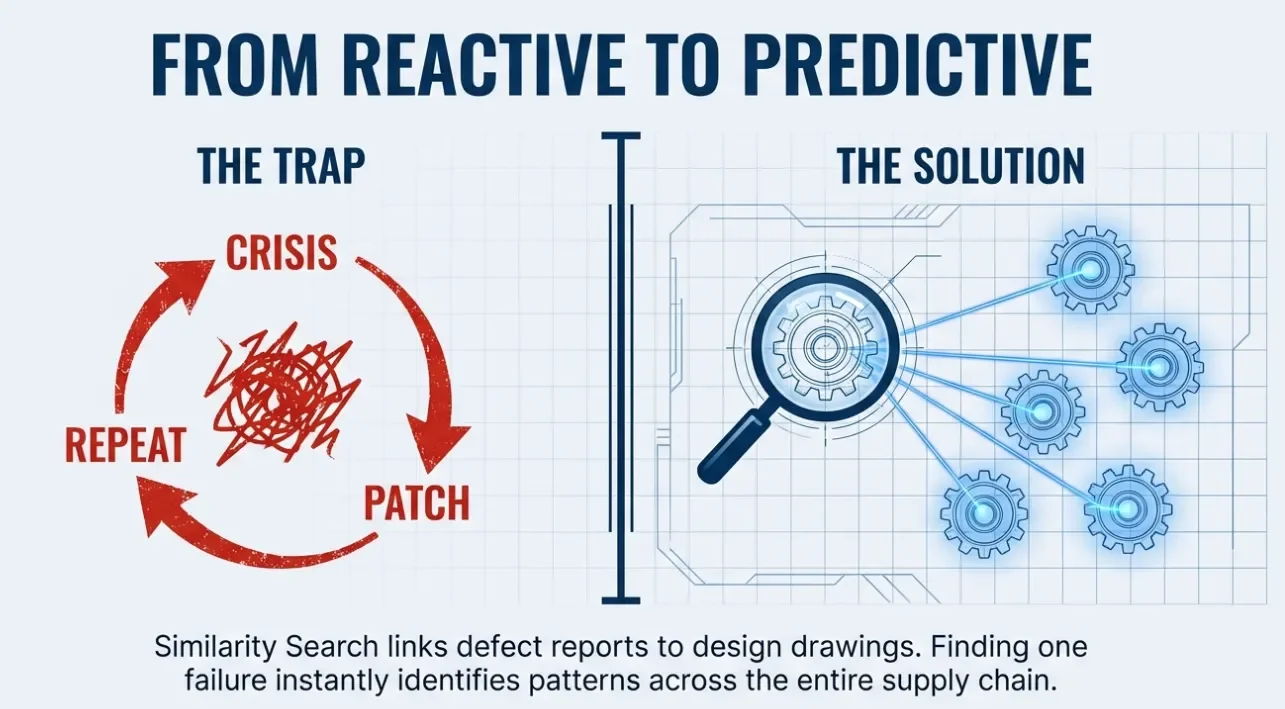
Breaking the "Firefighting" Loop
The Challenge: The most pervasive pain point in heavy machinery QA is the dominance of reactive crisis management. Engineers report spending the majority of their day "putting out fires"—segregating bad parts, debating with production managers, and writing emergency deviations. This constant reactivity leaves no time for the deep statistical analysis or systems design that actually prevents defects, fostering a high-stress environment where QA is socially isolated.
Why It Matters Now: In an industry characterized by high-mix, low-volume production, the inability to move from reactive to preventative quality control creates a "death by a thousand cuts" scenario for efficiency.
How CADDi Helps: CADDi transforms quality control from a reactive to a predictive system. By linking quality defect reports directly to design drawings and supplier histories, CADDi allows teams to identify patterns of failure. If a specific component fails, the platform’s patented similarity search can instantly find every other drawing in the system with similar geometric features or materials. This allows for surgical containment actions before a wider production halt occurs, effectively shifting the workflow from fighting fires to preventing them.
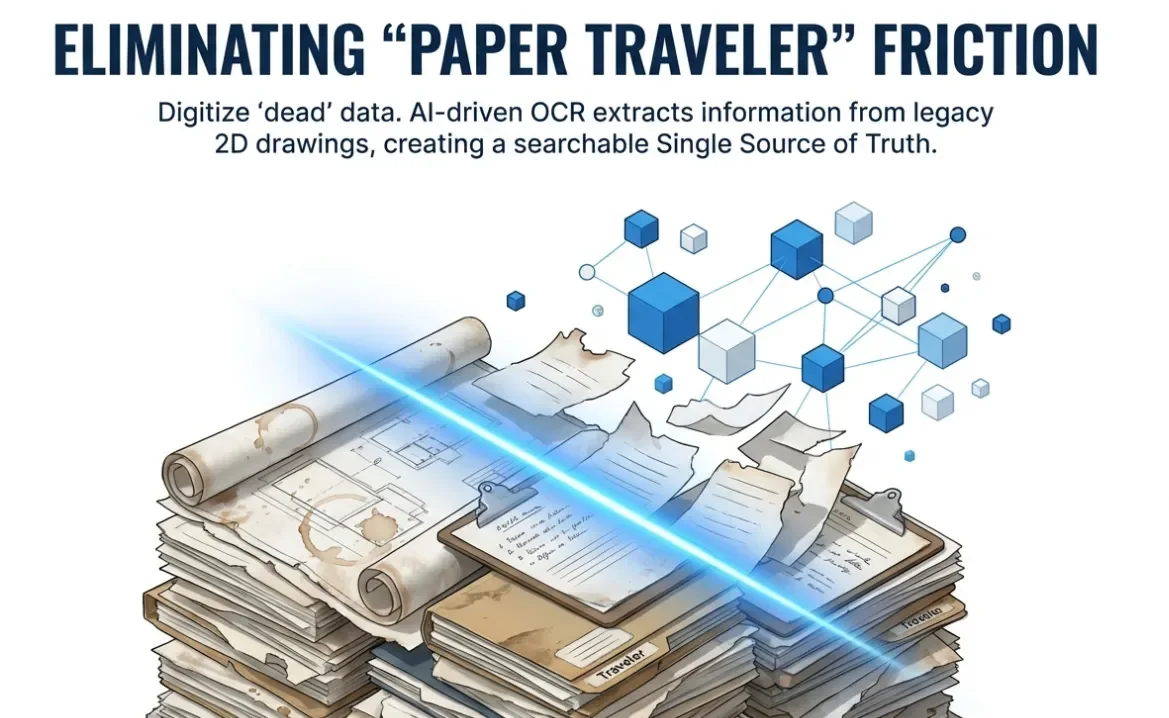
Eliminating the "Paper Traveler" Friction
The Challenge: Despite the industry's vocal pivot toward Industry 4.0, the shop floor reality for many QA professionals remains tethered to paper. The reliance on physical "travelers"—packets of documentation that must be manually stamped and signed—creates massive friction. Data collected via hand tools and written on paper is effectively "dead" until it is manually transcribed into a digital system, leading to lag, errors, and a lack of real-time visibility.
Why It Matters Now: As regulations tighten and production targets increase, the "data lag" caused by manual transcription compromises traceability and frustrates a younger generation of engineers who expect seamless digital integration.
How CADDi Helps: Explorer utilizes proprietary OCR-based AI to digitize and extract information from static documents, including legacy 2D drawings and handwritten notes. By centralizing this data into a searchable, digital format, CADDi eliminates the "paper anchor." This creates a single source of truth that connects design specs with inspection data, removing the administrative drudgery of manual entry and ensuring that 30-year-old drawings are as accessible and actionable as digital-native files.
Bridging the Legacy Asset and Knowledge Gap
The Challenge: Heavy machinery manufacturing is unique in the longevity of its capital assets; it is common to see modern lasers operating next to 50-year-old hydraulic presses. As the "Silver Tsunami" of retiring Baby Boomers accelerates, the "tribal knowledge" required to maintain quality on these legacy machines is disappearing. New hires often lack the intuitive understanding of machine idiosyncrasies that veteran operators possess.
Why It Matters Now: The loss of institutional memory is a major driver of downtime and quality variability. Without a way to capture this wisdom, plants face a catastrophic loss of process capability.
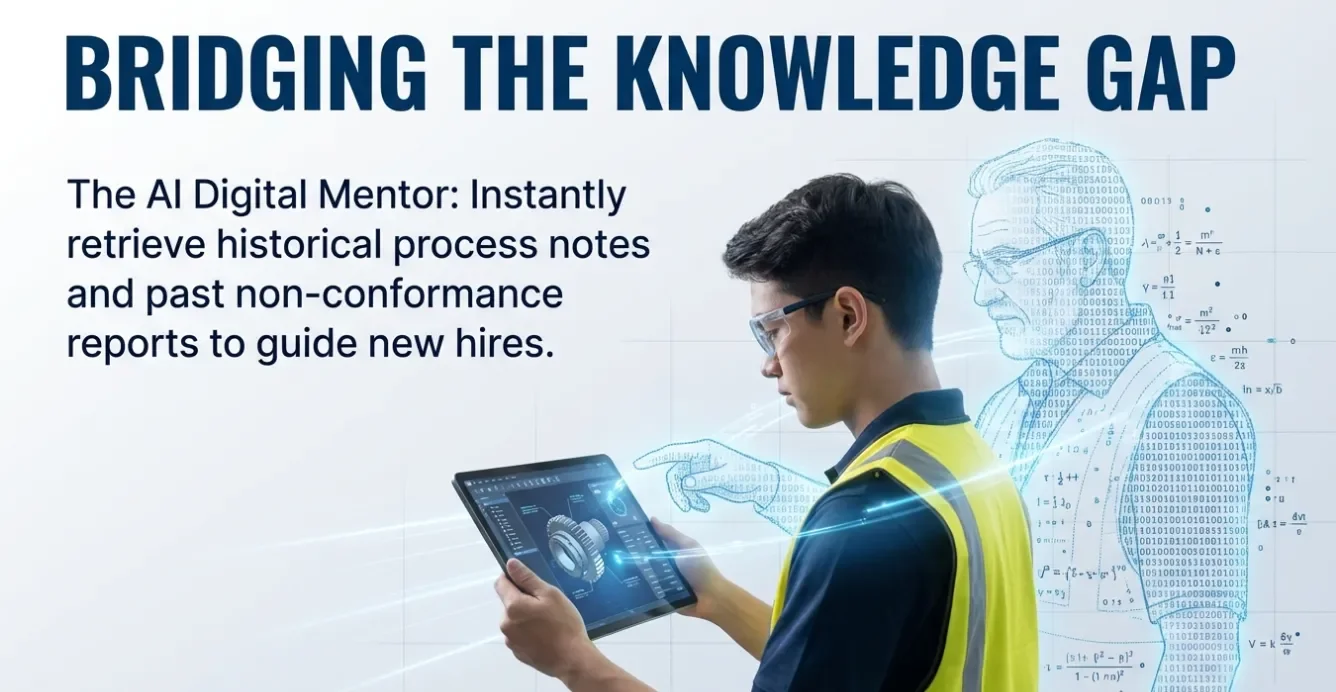
How CADDi Helps: CADDi acts as an AI-driven "digital mentor". By digitizing historical data—including process notes, past non-conformance reports (NCRs), and "tribal knowledge" regarding legacy parts—the platform creates a unified institutional repository. New hires can use similarity search to instantly access past projects to understand how specific quality issues were resolved previously, effectively democratizing expertise and accelerating onboarding.
Establishing the "Digital Thread" for Compliance
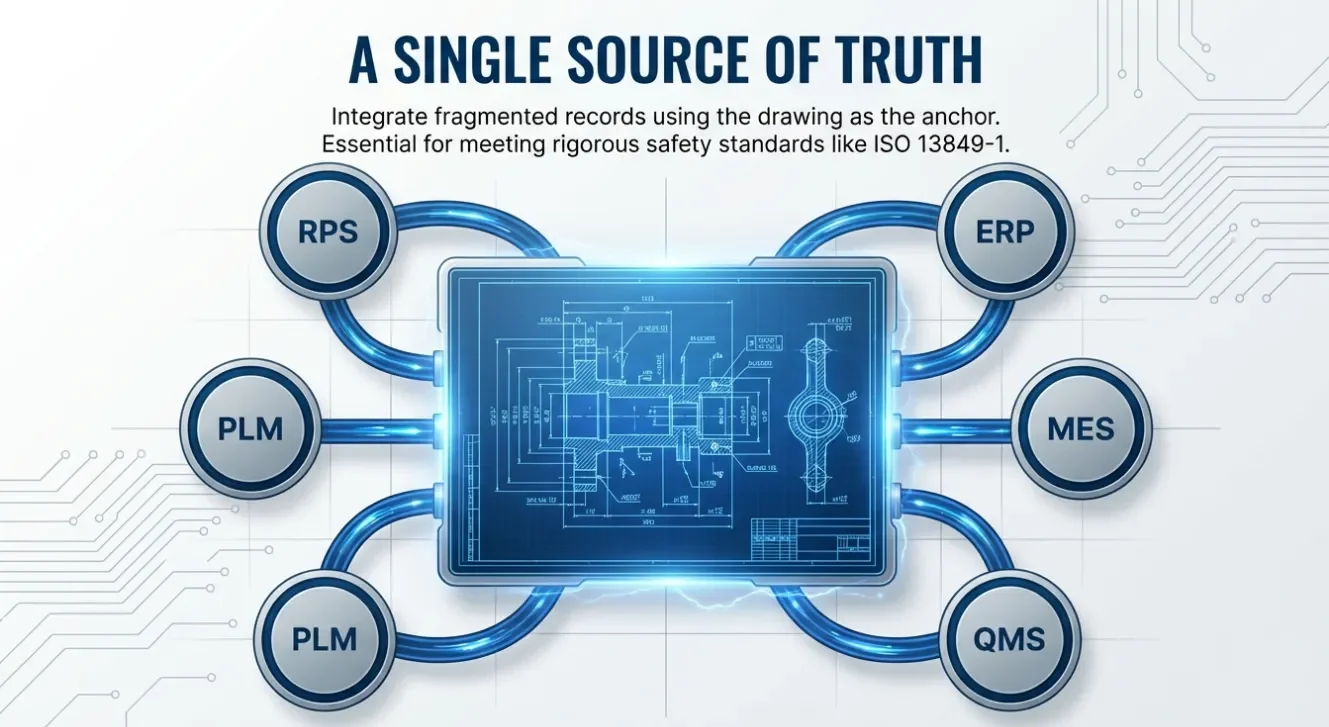
The Challenge: QA professionals currently have to log into five or six different software platforms (ERP, MES, QMS, PLM) to get a complete picture of a single quality event. This fragmented landscape makes it difficult to establish a true "Digital Thread"—an unbroken stream of data connecting design, manufacturing, and field performance—which is essential for meeting rigorous safety standards like ISO 13849-1,.
Why It Matters Now: With the rise of autonomous machinery and stricter Tier 5 emission regulations, the burden of proof for safety and compliance is higher than ever. Disconnected data creates compliance risks and audit nightmares.
How CADDi Helps: Explorer functions as an AI-driven data lake that integrates fragmented records from ERP, PLM, and QMS systems using the drawing as the central anchor point. This integration ensures that every stakeholder is working from the same data, enabling granular traceability where a serial number scan can reveal not just the date of manufacture, but linked quality reports and supplier certifications. This capability is critical for rapid root-cause analysis and surgical recalls.
Managing Welding and Fabrication Integrity
The Challenge: In heavy machinery, welding is the structural soul of the product. Defects in frames, booms, and chassis are the most significant technical challenge for QA teams. Identifying the root cause of weld defects across diverse suppliers and internal fabrication teams is often a manual, forensic process.
Why It Matters Now: Structural integrity is non-negotiable. A single weld failure can lead to catastrophic equipment failure in the field, liability issues, and reputational damage.
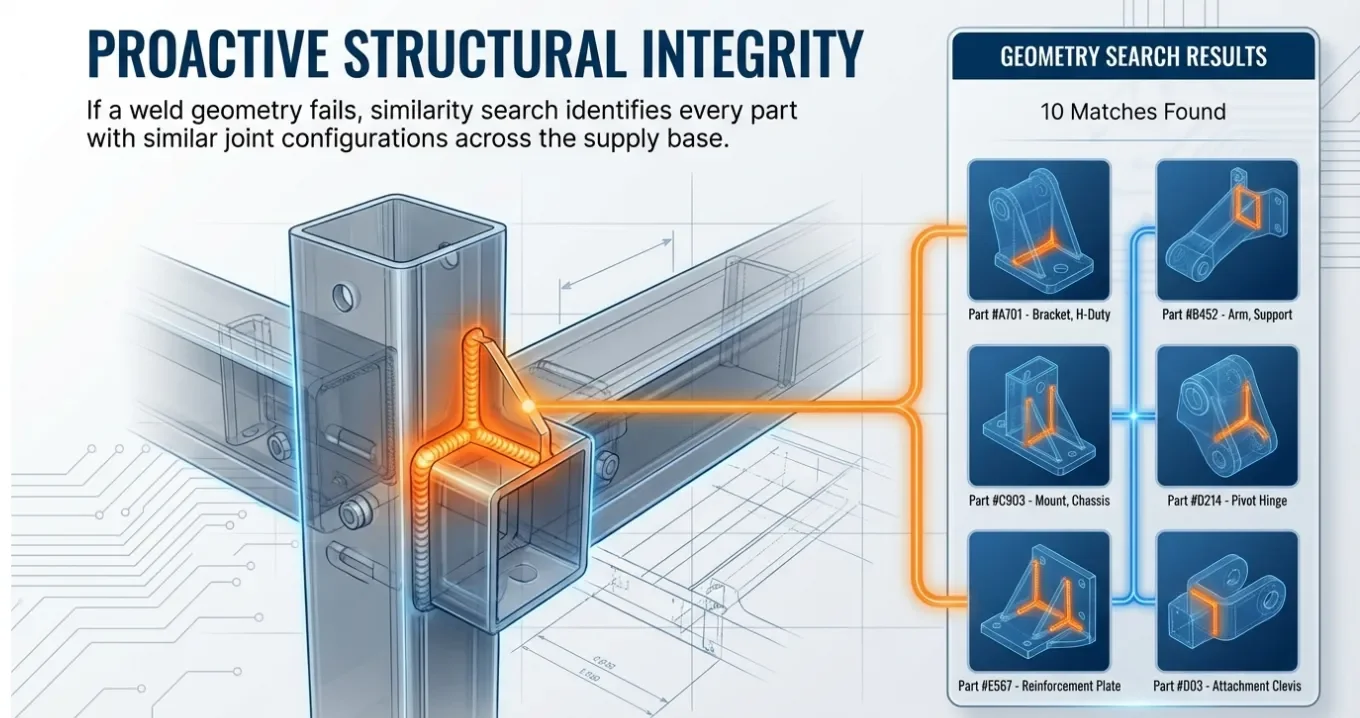
How CADDi Helps: CADDi enables proactive supplier quality management by linking part geometry to supplier performance data. If a specific weld geometry fails, QA teams can use similarity search to identify all other parts with similar joint configurations across the supply base. This allows engineers to proactively validate supplier capabilities for specific features and ensure that "lessons learned" from one defect are applied across the entire portfolio to prevent recurrence.
Conclusion: From "Villain" to Value Architect
The future of Quality Assurance in heavy machinery lies in moving beyond the role of the "policeman" who stops the line. By embracing digital transformation and leveraging AI to unlock the value of historical data, QA professionals can evolve into strategic partners who design the systems that make failure impossible.
By implementing a platform like CADDi, you can bridge the gap between legacy iron and the digital future, ensuring that your quality processes are as robust as the machines you build.
Ready to see how CADDi can bring your QA strategy into the modern era? Book a personalized demo today or explore our interactive experience.


