
Unleash Story

The Unexpected Impact of a Data Search Tool at Amerequip

This is an excerpt of article, "The Unexpected Impact of a Data Search Tool at Amerequip", originally featured in The Fabricator magazine
Growth is good for a metal fabricating company, but it’s not necessarily easy. The increased revenue is the headline, but the real story is how the shop can stay on top of the additional work while still meeting quality and on-time delivery goals.
Amerequip, Kiel, Wis., is a 106-year-old company that started out making farm implements, later added other products (such as the Snow Bird, a 1920s and ’30s vehicle with snow tracks, several of which were used in Admiral Richard Byrd’s expeditions to the South Pole), and finally found its way to becoming a contract manufacturer for major OEMs, beginning with John Deere in the 1980s. The latter move has proven a smart one, as major OEMs have increasingly sought to outsource metal fabricating services and focus more on final assembly.
"John Deere is a great example of a customer we like," said Peter Stilp, Amerequip’s business development manager. "We started out small in their ag division, and then we got into their turf division. Now, we’re doing all of that, and we’re into their construction division."
Amerequip, a shortened version of American Equipment, now is a supply chain partner for not only Deere but also Caterpillar, the McNeilus Refuse (a business unit of Oshkosh Corp.), and other large manufacturing companies with global distribution for their products. This customer roster has grown with Amerequip’s commitment to support its customers along every step in the process—from design for manufacturing services to shipping. It’s one of the reasons the company has recently automated a paint line, purchased a 650-ton press brake, and added 32,000 sq. ft. of manufacturing space to accommodate a new large fabrication project. Amerequip is more than willing to make the proper investments to grow with its customers. (For the record, the metal fabricator is No. 28 on The Fabricator’s FAB 40 list. It reported $75 million in revenue for 2025 and projects $86 million this year.)
But success brings complexities. One of the major challenges that Amerequip has had to wrestle with is the burgeoning number of part files—about 67,000 active files with drawings, according to Vice President of Engineering Tim Dorn. He’s seen the part files grow—along with frustration in the engineering department—over his 16 years with the company.
"Let’s say when we’re designing a product and there are some parts that are similar to what we’ve used in the past. At that point, we would have to use the memory of engineers to help with the manual searching to try and find that file," he said. "And frankly, that didn’t happen that often because it was such a challenging process."
THE DIGITAL DOMAIN
Like other metal fabricating companies, Amerequip has experienced some painful digital migrations. Dorn wanted to avoid that if possible.
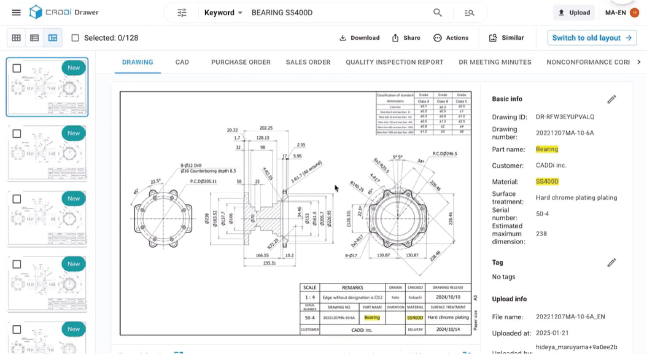
With CADDi Drawer, Amerequip personnel can conduct a keyword search of drawings, CAD files, and other documents.
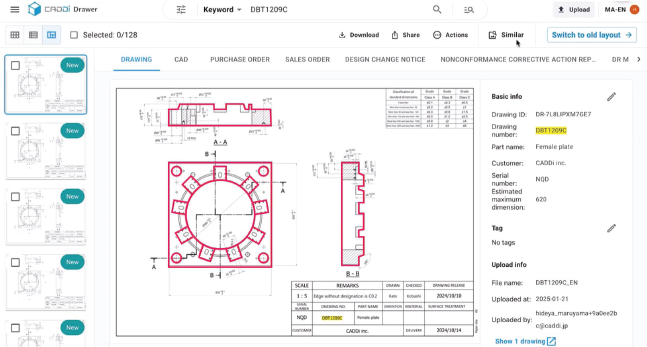
CADDi Drawer can analyze different shapes that might be found in documents and return them in search queries.
Part of the plan to minimize obstacles was to appoint an engineer who could become the in-house expert for using CADDi and help set up the software. Stella Rezabek, a mechanical designer in the engineering department, got the call.
"She was the tip of the spear in working with CADDi. She gets everybody here at Amerequip engineering in line, asked the right questions, and really coordinated things," Dorn said.
She also was responsible for uploading the files, working closely with CADDi project managers. Dorn recalled that most of the files didn’t require alterations. Bulk uploads of the drawings and other documents made the process a task that a small team could handle.
By January 2026, engineers started dabbling with the new platform. The results caught the attention of people using the search capabilities.
"I envisioned this would be exactly where it’s driving—speeding up the search for information," Dorn said. "But now I shouldn’t even be saying that, because I didn’t think it was going to be this much information that we were going to be able to pull up."
Dorn recalled a recent product development project involving a lawn care application where a project engineer wanted to look for a similar assembly from a few years ago. In a matter of seconds, he pulled up the file, extracted the components of the assembly he wanted to use in the new product design, and was able to quickly determine the cost for those parts.
CADDi Drawer also had been useful in avoiding the creation of duplicate part numbers. Say an engineer reviews a customer’s bill of materials and sees a component with a generic description and no drawing reference or additional identification. Before the implementation of the digital repository, the engineer likely would have created a new part number and issued a new purchase order, simply because it was difficult to locate a past reference to the component. CADDi’s keyword search and flexible matching logic can identify that component in a previously used part drawing, even if it has a different description than what was included on that original bill of material.
Dorn said this opened the door to parts knowledge that the engineering staff never had before. They can see all parts ordered by Amerequip, not just the ones that the engineering staff had a role in purchasing.
Project engineers aren’t the only ones finding CADDi Drawer useful. Dorn said the quality team was averaging about 250 to 300 searches per week by early summer. That could be just the beginning.
"When you look at making a decision on whether something needs to be changed or whether an action is going to affect something, it’s all about do you have the right data in front of you. In the past, you would have to go over to this area for finances, another area for the actual print and technical data, and other areas for quality reports, scrap warranty, customer issues, logistics, and all sorts of other stuff," Dorn said. "Now, potentially, we’re going to be able to pull this into one location where we can find it in one quick search."
This digital domain has become the organizational brain that is able to remember things that escape veteran employees or that newer employees never knew. It’s proving more effective than a collection of networked drives and smart file organization ever could.
Read the full article on The Fabricator Magazine:
https://www.thefabricator-digital.com/thefabricator/library/page/202608/46/